
What Year Was My Hobart M. Cable Piano Made?
(Serial Number Lookup + Guide)
DIRECT ANSWER
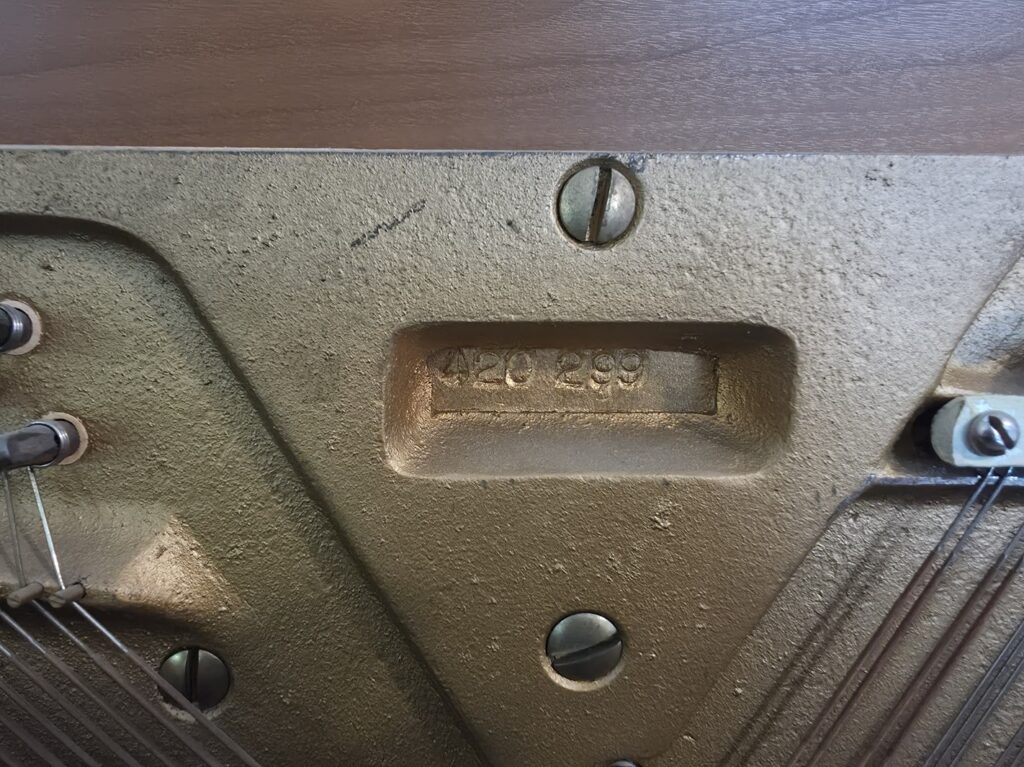
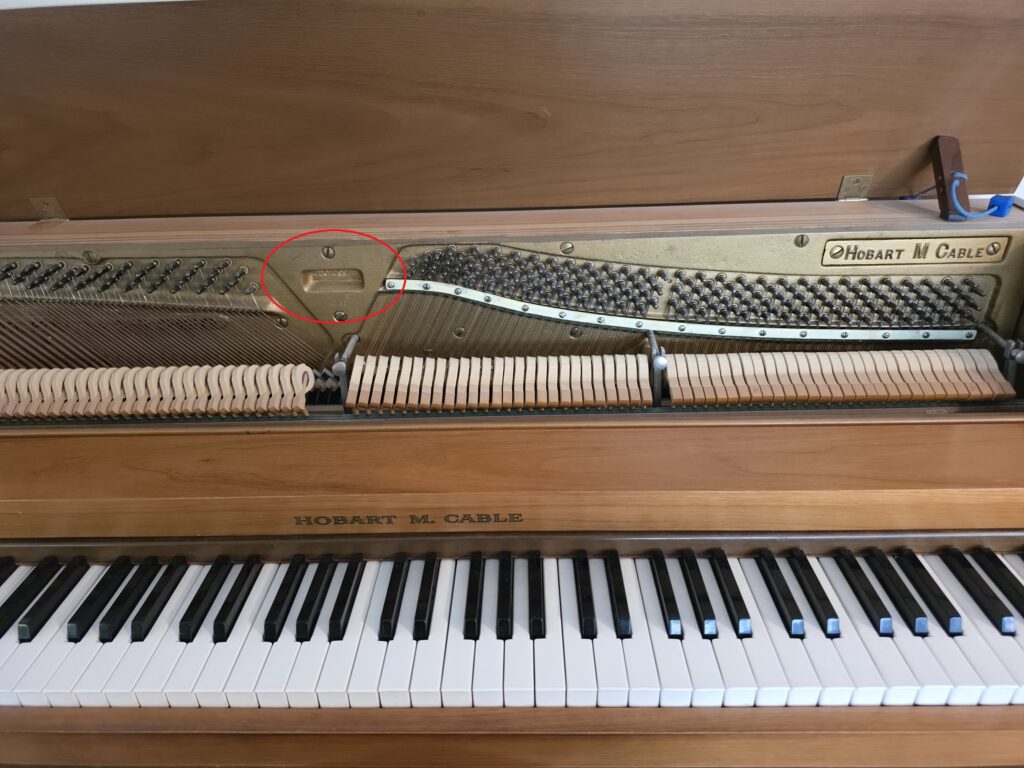
Original American-made Hobart M. Cable pianos can generally be dated from their numeric serial numbers. On grands, look on the cast-iron plate near the tuning pins; on uprights and spinets, check inside the upper cabinet near the strings, action, and tuning pins.
The key distinction is the serial format. A numeric-only number may belong to the original American sequence covered by this lookup. A letter-prefixed number, such as T 80026, RF 8092, or KF 8182, indicates a later serial-number system and cannot currently be dated by this tool.
HOBART M. CABLE SERIAL NUMBER LOOKUP TOOL
Your piano was manufactured in .
Would you like a free, personalized certificate documenting your piano's age? Perfect for keeping in your files or your piano bench.
No email or login needed, just click and print!
Sample Certificate

Want to know how much this piano is worth?
Get a professional piano valuation report with its estimated value, place of manufacture, and other important details—useful for insurance, estate records, and buying or selling a piano. Your report also includes a printable valuation certificate.
If your piano has little or no market value, you won’t be charged.
Sample Valuation Report — Page 1

AMERICAN VS. ASIAN HOBART M. CABLE SERIAL NUMBERS
If your Hobart M. Cable has a numeric-only serial number, it belongs to the original American production sequence covered by this lookup tool.
If the serial number begins with a letter or letters, it is generally indicative of a later Asian-made Hobart M. Cable and should not be dated using the American serial-number sequence.
Examples of later Asian serial formats include:
• T 80026
• RF 8092
• KF 8182
These examples are associated with later Hobart M. Cable instruments rather than the original American production sequence.
The prefixes themselves are part of the later serial-number system. Available historical documentation does not establish a reliable public decoding system in which each individual prefix corresponds to a particular year. Therefore, prefixes such as T, RF, and KF should be treated as identification markers for the later production system, not as year codes.
Our database currently does not contain the Asian serial-number system and will not identify the year of an Asian-made Hobart M. Cable piano.
WHERE IS THE SERIAL NUMBER ON A HOBART M. CABLE?
HOBART M. CABLE GRAND PIANOS
On a grand piano, begin by opening the lid and examining the cast-iron plate and the areas surrounding the tuning pins.
The serial number may be stamped directly into the plate or found on another internal surface depending on the production period.
Later revival-era grand pianos can have completely different identification conventions from the original American instruments.
If you find a letter-prefixed serial number on a modern Hobart M. Cable grand, do not enter it into an old American serial-number chart simply because the piano carries the Hobart M. Cable name.
HOBART M. CABLE UPRIGHT PIANOS
On an upright or console, open the top lid or upper cabinet and look inside the piano near the strings and action.
The serial number may be:
• stamped into the metal plate
• stamped or marked on the wooden structure inside the piano
• located near the tuning pins or upper action area
The exact location varies considerably between models and production periods. Several documented Hobart M. Cable identification examples place the relevant number inside the instrument near the strings rather than on the exterior cabinet.
Do not assume that every number found inside the cabinet is the serial number. Pianos can contain additional numbers associated with individual parts, cabinet construction, patents, or other manufacturing information.
DO NOT USE THESE NUMBERS
Model numbers, such as GP-178 or UP-118.
Patent dates or other numbers cast into the plate.
Cabinet, component, or construction numbers.
A letter-prefixed later serial number entered as numbers only.
“Cable” or “Cable Nelson” in place of “Hobart M. Cable” in the lookup tool.
A letter prefix is part of the later serial-number system. Do not remove it or apply the original American numeric sequence to that piano.
WHAT A HOBART M. CABLE SERIAL NUMBER CAN TELL YOU
For an original American Hobart M. Cable, the serial number can usually establish an approximate manufacturing year and production era. Grand pianos made from 1926 through 1929 used a separate serial-number sequence, so an unusually low number on a grand from that period may be legitimate.
The serial number cannot establish the exact day or month of manufacture, sale date, time spent at a factory or dealership, condition, current value, or later rebuilding and modifications. It dates the instrument, not necessarily every component now installed in it.
HOBART M. CABLE PIANO HISTORY
Hobart M. Cable pianos were first manufactured in the United States in 1900, initially in Chicago and later principally in La Porte, Indiana. The original company made uprights, grands, player pianos, and other instruments; this is the era represented by the American serial-number records in the lookup.
The original company remained in operation into the 1960s.
Story & Clark later used the Hobart M. Cable name, sometimes as “Hobart M. Cable by Story & Clark.”
America Sejung registered the brand in 2002 and sold Chinese-made upright, console, and grand pianos under the name until around 2011.
These later instruments may use letter-prefixed serial numbers and are not part of the original American sequence.
Reviewed by Joe Kemple, Master Piano Technician, Burd and Sons Piano Service · Updated September 2026
Our database covers Hobart M. Cable serial numbers across the major production periods represented in historical records, helping you distinguish an original American Hobart M. Cable from later instruments that used the same brand name.
Copyright © 2019 – present, Burd and Sons Piano Service